
Acid Research
WSA14 Improving Road Durability in Acid Enviroments
Soil Stabilization Technology Designed For Extended Service Life.
Cement Failure in Acidic Mine Enviroments
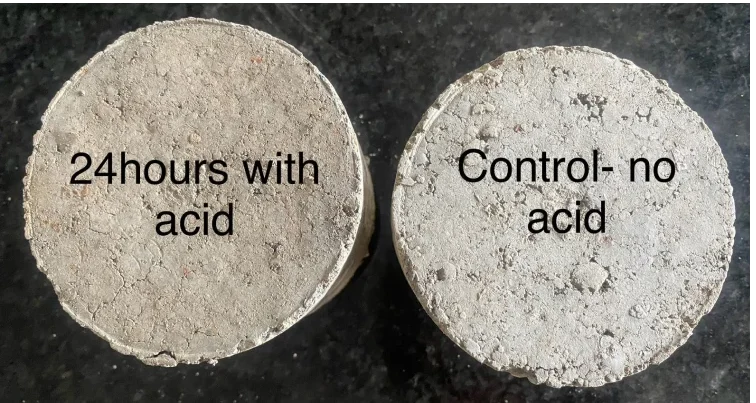
Mine sites are routinely exposed to aggressive chemical environments, particularly oxidizing acids such as nitric acid (HNO₃). Under these conditions, traditional cement-based stabilization methods degrade and lose effectiveness, resulting in premature failure when subjected to prolonged acid attack.

Infrastructure Degradation Leads To:
- Safety risks
- Increased maintenance
- Environmental liabilities
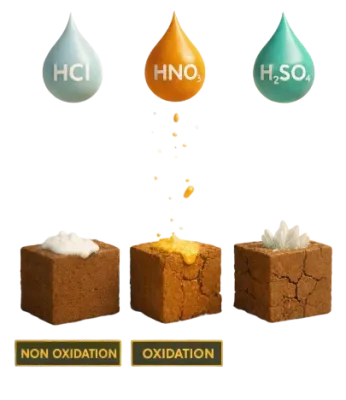
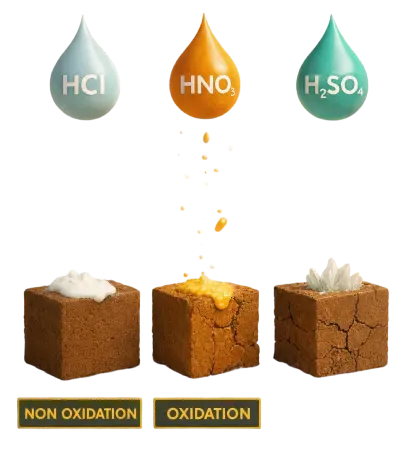
Acid Types & Mechanisms
- Acid Type Nature Reaction Mechanism Impact on Soil Matrix
- Hydrochloric (HCL) Non-oxidizing Dissolves calcium compounds Surface erosion
- Nitric (HNO) Oxidizing Oxidizes organics + leaches Ca Deep structural decay
- Sulfuric (H2SO4) Oxidizing Forms gypsum, expands matrix Cracking, spalling
Cement Under Attack
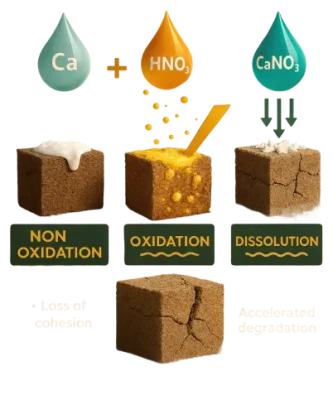
- Cement contains free calcium hydroxide (Ca(OH)2)-highly vulnerable
- Nitric acid forms calcium nitrate (Ca(NO3)2)→ highly soluble → leaches out
- Leads to: Loss of cohesion
- Cracking and dusting
- Accelerated degradation
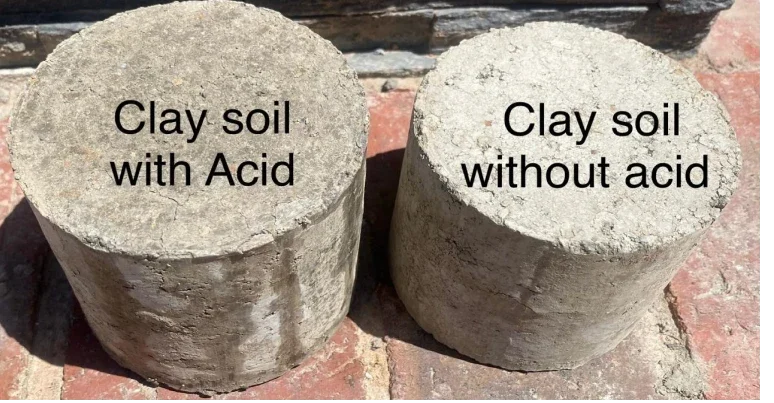
The hydrogel fills pores and initiates progressive cementation, blocking pore throats while densifying and hardening over time. This permanently reduces porosity and significantly lowers permeability.
As the system matures, ionic crosslinking forms durable chemical bonds, creating long-term cementation. The formulation allows deep penetration before gel set, ensuring uniform coating of soil particles and continuous matrix formation—critical for sealing connected pore pathways.
Technical Reference for Engineers
Mandatory Laboratory tests before dosing
Soil Characterisation
Gain a clear understanding of
in-situ material properties
before treatment:
Particle size distribution
Atterberg limits
Moisturedensity relationship
Organic content
Calcium content
Baseline permeability
Performance Testing
Evaluate treatment
effectiveness and long-term
durability:
Permeability
(constant/falling head)
CBR / UCS at 7, 28, 90 days
Moisturedensity relationship
Wet-Dry durability
Immersion/washout
resistance